Bell Booster Stations can be used when pumping beyond the maximum discharge distance of the dredging pump is required. With multiple Booster Stations in the discharge pipeline the material can be dredged miles away!
The Bell Booster Station can be either diesel powered or electrically driven.

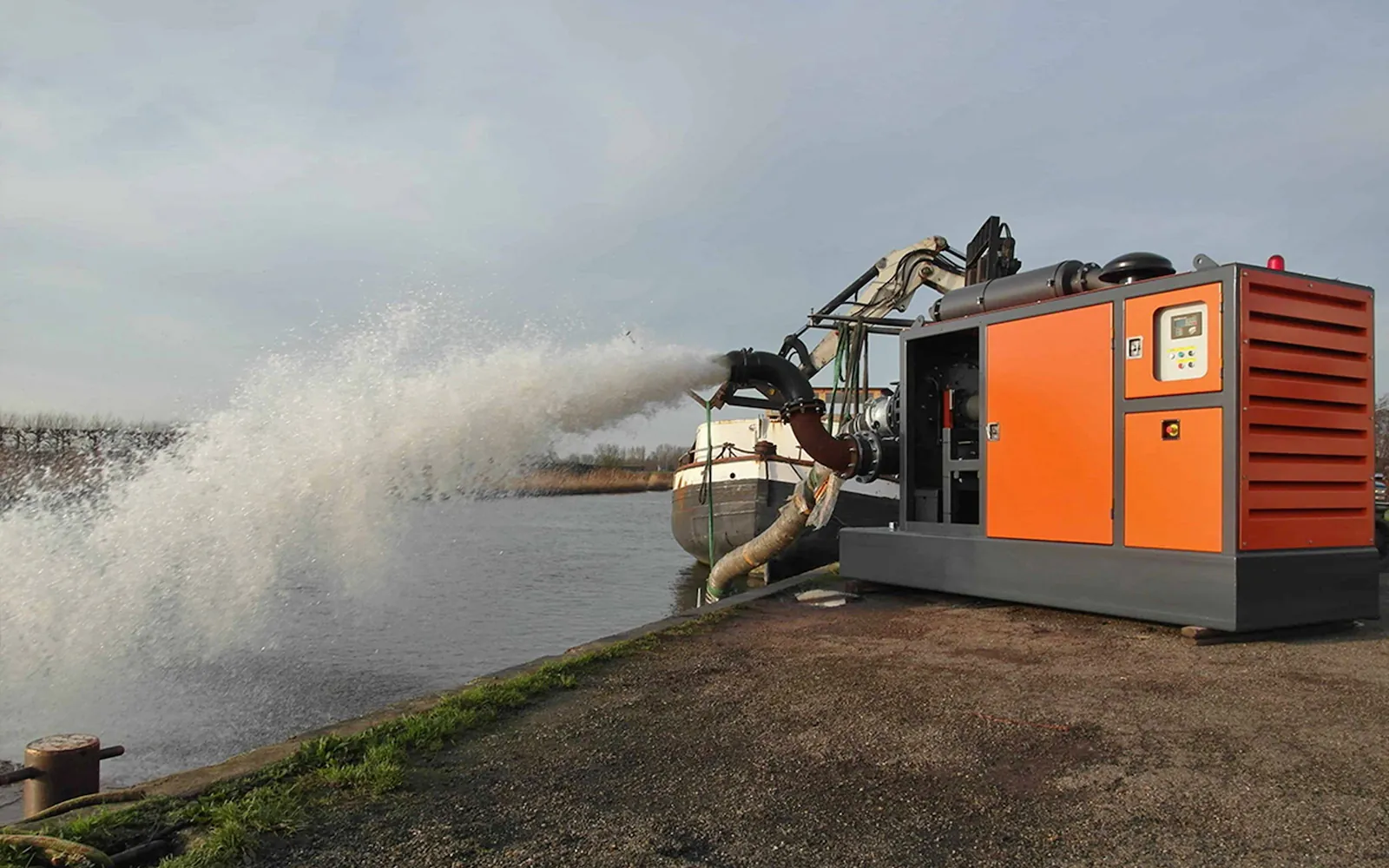

The Booster Station is placed in a frame with a built-in diesel tank at the bottom. In the upper part of the frame multiple ventilation grids are installed as well as doors for efficient maintenance on the diesel engine. The pump is situated outside the canopy, facilitating easier hose connections.
We can tailor the design to suit your unique requirements. Please contact us for more information!


The electric version drives the pump with an electric motor, mounted on a base frame next to the pump. Choose it when the site has the power supply for it. The diesel version carries its own fuel tank, so it can run without a grid connection.
Bell builds booster stations from the Bell 100 to the Bell 400. The power per model:
Capacity and discharge figures depend on the configuration. Ask us for the details of the model you are considering.
A dredge pump can only push the mixture over a limited distance. When the discharge line has to be longer, a stand-alone booster station is added to the line. It keeps production up over the total discharge length. You can place several booster stations in the same line, and in that way the material can be dredged miles away.
Related equipment: Bell dredge pumps, cutter dredgers and A-frame dredgers, the machines that feed the discharge line.
A booster station is a pump unit in the discharge line. It adds pressure so that the mixture of water and solids reaches a disposal site that is further away than the dredge pump can manage alone.
When the discharge distance is longer than a single dredge pump can cover. The longer the line, the more stations you place along it.
Both are available. The diesel version has a built-in diesel tank and engine doors for maintenance, and the pump sits outside the canopy for easy hose connections. The electric version uses an electric motor. Choose on the power you have at the site.
From 55 kW for the Bell 100 to 560 kW for the Bell 400.
Yes. Multiple booster stations can be placed in the discharge pipeline.