An A-frame dredger is a floating platform that suspends a Bell dredge pump from an A-frame at the bow, which is what gives it a dredging depth that other vessel types simply cannot match. Below, we explain how an A-frame dredger works, why its depth is nearly unlimited, and how the Bell A-Frame Dredger models compare.
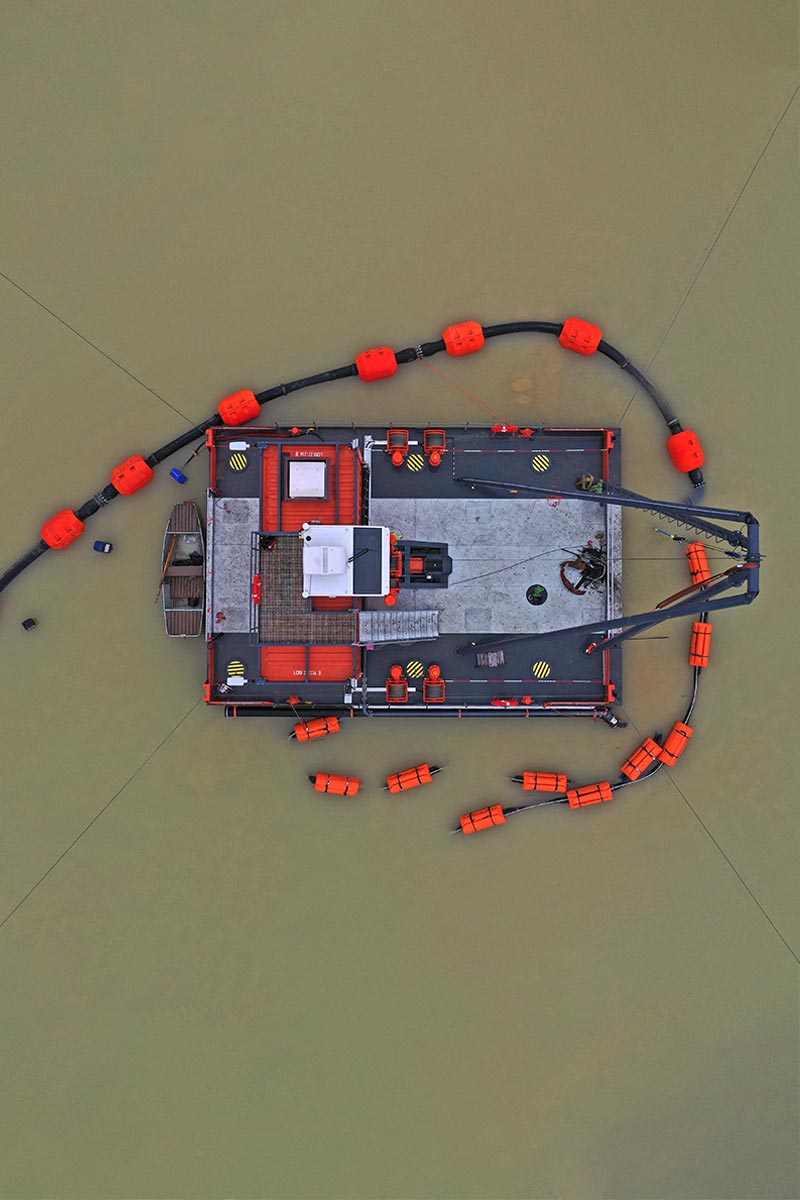
An A-frame dredger is a diesel or fully electric driven floating platform, held in position by a four-point mooring system. Instead of a fixed pump on the hull, the Bell dredge pump hangs freely from an A-frame at the bow, suspended by cables rather than mounted on a ladder.
That free-hanging setup is what sets an A-frame dredger apart from a cutter or pontoon dredger: because the pump is not fixed to a rigid frame, it can be lowered to virtually any depth the cable allows, up to 100 metres according to Bell’s specifications. Operation happens from the cabin, and the vessel has a large open deck, which keeps maintenance and head changes straightforward.
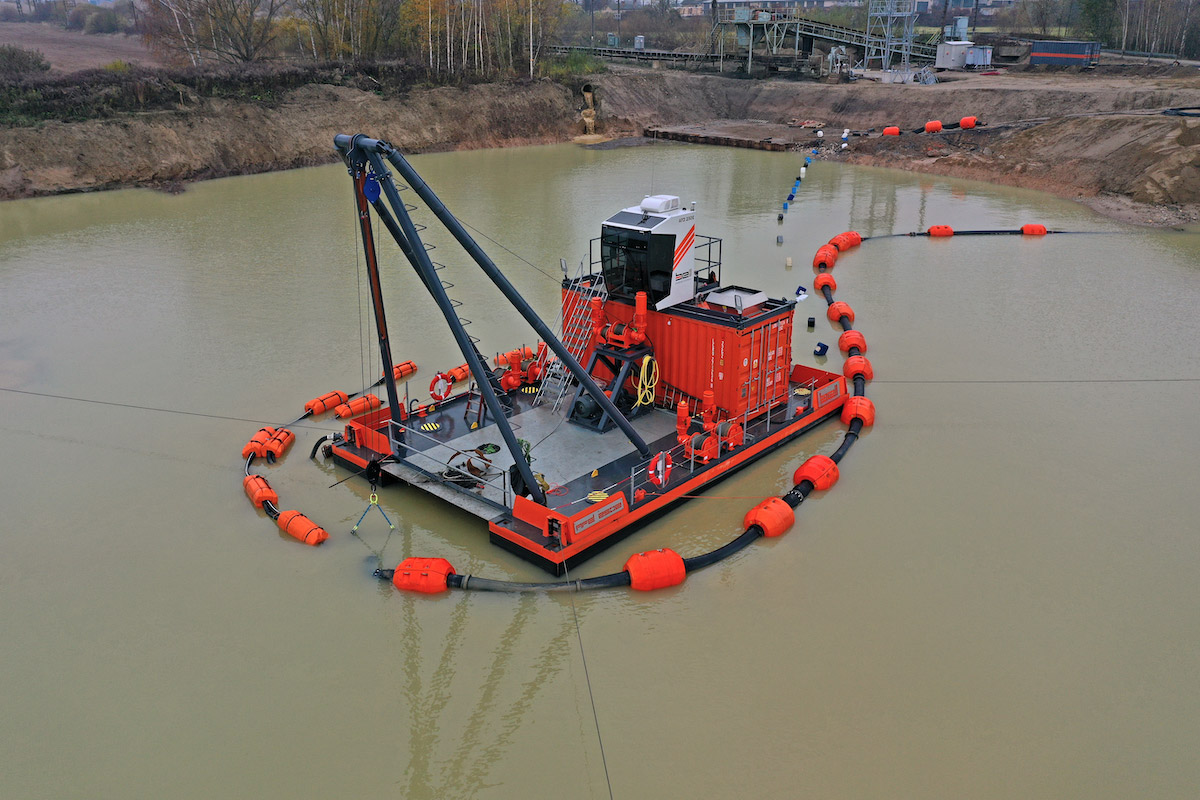
What gives the A-frame dredger its near-unlimited dredging depth is simple: there is no ladder or frame length limiting how far the pump can travel. The cable suspending the pump from the A-frame can be paid out to depths that a cutter dredger or pontoon-mounted dredger cannot reach, which is why this type is often chosen for deep reservoirs, quarry lakes and other projects where depth, not soil hardness, is the main challenge.
The pump itself can be fitted with a sand production head for loose ground, or a double cutter head when the material is more compact. Because the head hangs freely rather than being fixed to a ladder, it can also follow uneven or sloped underwater terrain more easily than a rigid-mounted setup.
Bell builds the A-Frame Dredger in three sizes: 250, 300 and 350. All three share the same 4-point mooring platform and up to 100 metres of dredging depth, and are available diesel driven or fully electric. The difference between them is the pump: the 250 and 300 versions are built around the Bell 250 and Bell 300 pumps respectively, with mixture capacities of 1250 and 2000 m3/h.
As with the cutter dredgers, all A-Frame Dredger models accept the same interchangeable heads, so the choice of model mainly comes down to the volume of material to be moved.
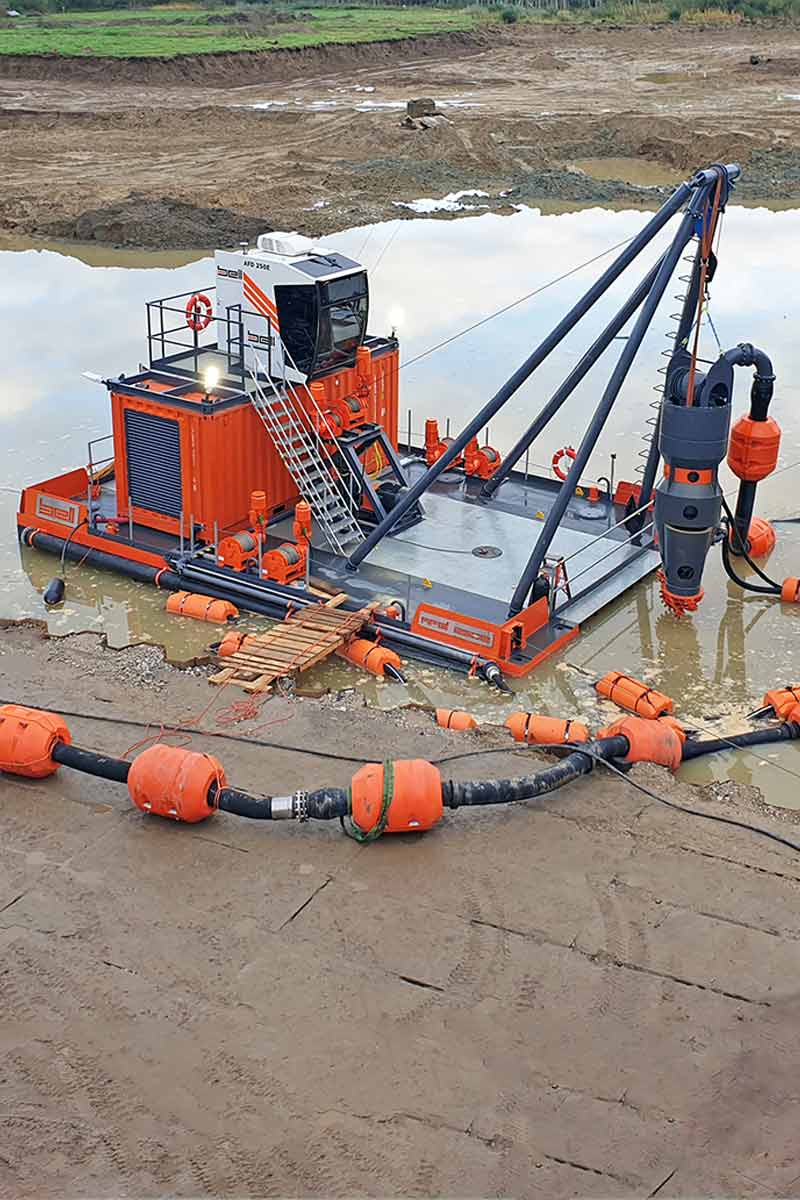
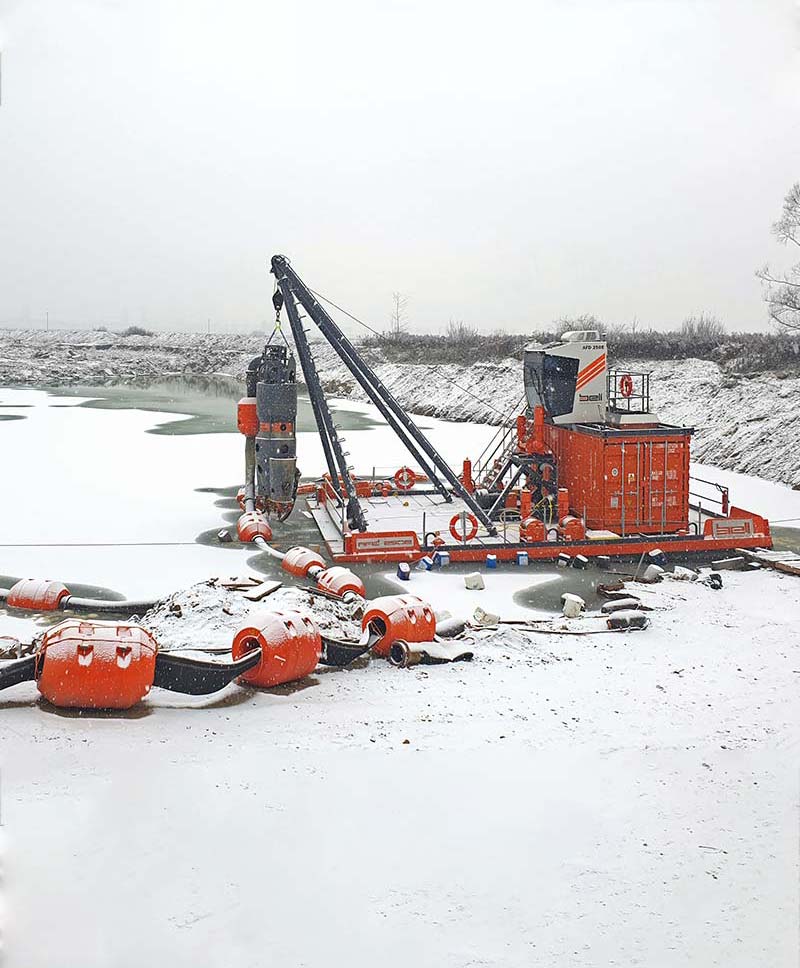
Because depth is rarely the limiting factor, an A-frame dredger is typically chosen for reservoirs, deep quarry lakes and other sites where the water is too deep for a cutter dredger’s fixed ladder, or where the project calls for a fully electric vessel to reduce emissions on site. The large open deck also makes it easier to swap heads or carry out maintenance between jobs.
For shallower projects where the priority is cutting through compacted soil rather than reaching extreme depth, a cutter dredger is usually the better fit.
Our A-Frame Dredgers are built in-house and available for sale and rental, in diesel or fully electric versions. Have a look at the full Bell A-Frame Dredger range, or contact us to discuss depth, capacity and head configuration for your specific site.

